Designing My Life OS: How I’m Using My iPhone, Habits, and Systems to Shape 2026

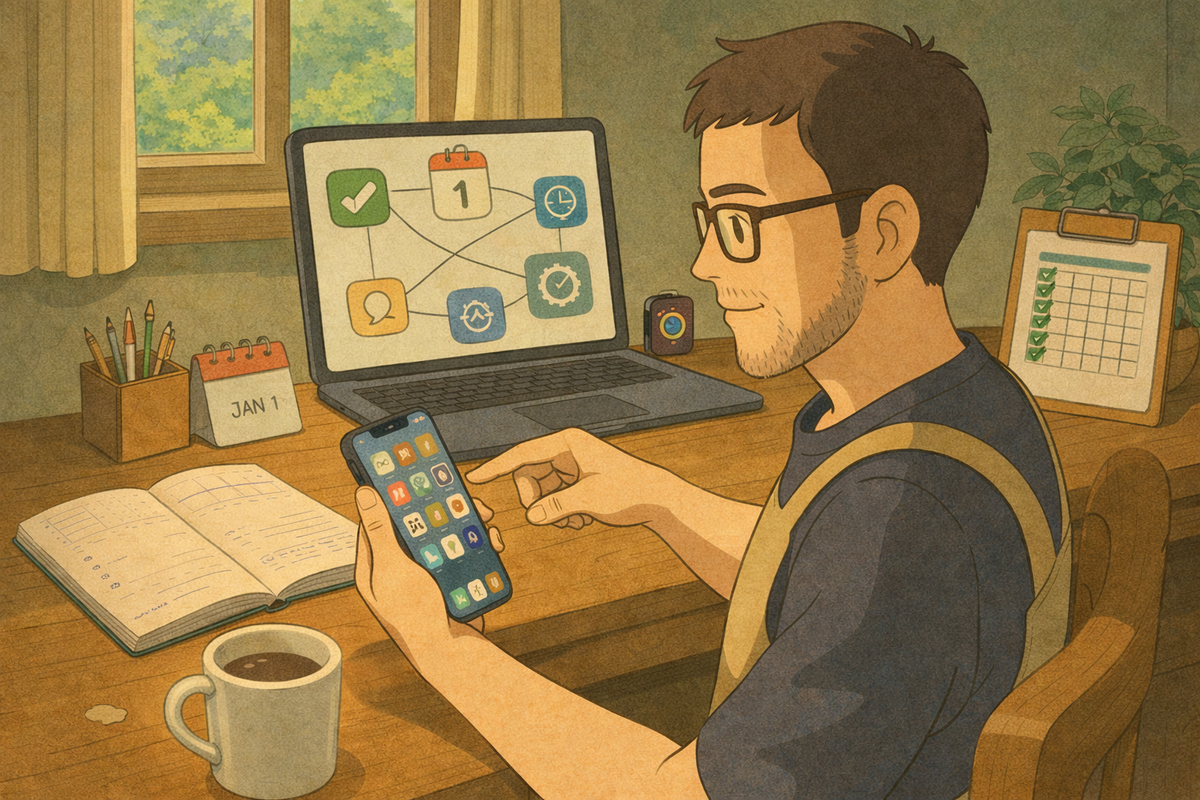
In late 2025, I found myself caught in a loop.
I was building apps designed to reduce friction, help people track mindfully, and support healthier habits — but my own environment wasn’t serving me. My phone was noisy. My routines were reactive. And I felt like I was living slightly out of sync with the life I actually wanted to build.
So I decided to reset everything.
Not with a shiny resolution or some notion of “optimising” productivity — but by designing the systems and surfaces I interact with every day. Starting with my iPhone. Then my daily routines. Then the defaults that shape how I think, feel, and work.
This is the OS I’m carrying into 2026.
The Reset: One Screen, No Distractions
I started with my iPhone — because that’s where most of my attention leaks were happening.
What I realised was simple: if an app is on my Home Screen, I’ll open it on autopilot. And if I’m opening something without intention, it better be something I actually want in my life.
So I deleted a bunch of apps. Others I removed from my Home Screen entirely. Even apps I love — like Helm, Driven, and yes, even my own products like AteIQ and Upp — were moved to the App Library.
Now, my Home Screen is one screen only. No folders. No red badges. No junk. Just the apps that support planning, capture, or logistics.
The rest? Out of sight.
This wasn’t about digital minimalism for the sake of it. It was about making space for better habits.
My Life OS: The Habits I’m Committing to in 2026
This is what I’m waking up to every day:
- Read a physical book
- Hydrate often
- Strength training
- Walk 7–10k steps
- No added sugar
- Mindfulness
- Sleep by 10pm / wake at 6am
- Journal (physically + digitally)
I’m treating this as my daily operating system — not a to-do list.
Each habit is a vote for the kind of person I want to become. And if I miss one, I don’t spiral. I just pick up where I left off and keep going.
Designing for Consistency (Not Perfection)
This isn’t about perfect days. It’s about designing defaults that hold up — even when life gets messy.
A few things helping me stick with it:
- My iPhone reset: If it’s not on my Home Screen, it’s not in the way.
- Journal rituals: I write physically and digitally — sometimes ideas, sometimes feelings, sometimes just what happened.
- Weekend variant: My Saturday/Sunday OS is looser. Less structure. Still intentional.
- Bad-day fallback: If everything goes sideways? A walk, a cup of water, and five mindful breaths. That’s the bare minimum I commit to.
None of this requires motivation. Just design.
Where This Is All Headed
I’m not trying to become a productivity machine.
I’m trying to build a life that feels calm, creative, and deeply mine. I want to show up better — as a builder, a father, a partner, a human.
That means staying focused on:
- Evolving apps like AteIQ with integrity
- Growing MRR to support a sustainable indie path
- Writing more — especially about AI, Swift, and human-centred design
- Continuing to treat context as a design superpower
- Staying curious about where AI-native design is headed
Everything I’m building — from product to lifestyle — stems from one question:
Is this aligned with the life I actually want to live?
If You’re Designing Your Own Life OS…
I’d genuinely love to hear about it.
What habits are you committing to?
What’s on your Home Screen?
What defaults are you resetting for 2026?
I’ll be sharing more soon — from journaling systems to mindful tracking, indie dev reflections to MCP patterns.
If you’re exploring this space too, I’d genuinely love to connect or you can drop me a line.
Until then:
Build systems that support you.
Structure your context.
And design your life like it matters.